For a long time, vulvodinia was an unnamed pain, difficult to talk about and often questioned. Today it is talked about more, but medical recognition is not always enough to restore meaning and heed to an experience that involves the body, psyche, and deepest intimacy of women who suffer from it.

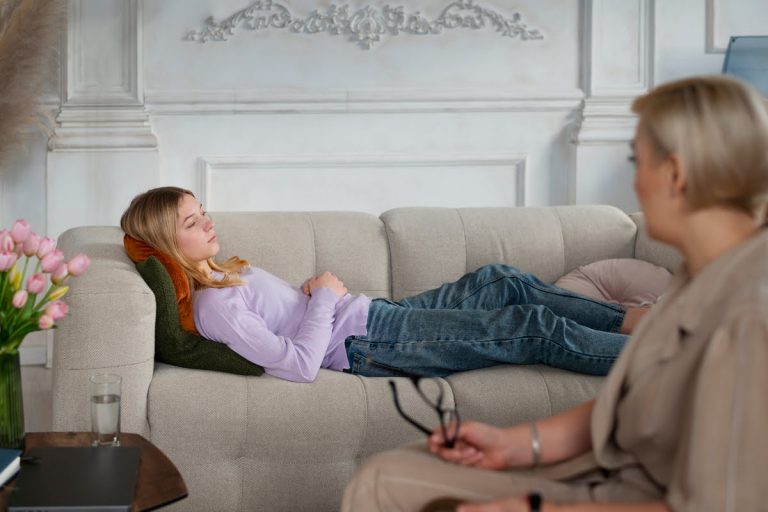
In this interview, psychoanalyst Grazia Aloi takes us on a reflection that goes beyond diagnostic labels, bringing attention back to the subjective experience of patients and the time it takes for pain to be told. From the therapy emerges a vision of vulvodinia as a complex experience, which cannot be reduced to a single cause nor explained with easy links between trauma and symptom. Body and psyche dialogue, but always in individual ways that demand respect, listening and competence.
Today there is more and more talk about vulvodinia. But until a few years ago, women were not believed and the condition was not recognized by medicine. How has the narrative of women in session changed? Is there a before and an after?
In my clinical practice no, there is no before and after except in having an intelligible name for the syndrome.
If one wants to talk about narrative times, before and after are — always and in any case — related to the right time, to the kairos that the Greeks left us saying. The right time, the time of when the patient is ready to talk about “that thing there” even if she came to analysis for that very thing there. It takes its time, which is not related to the recognition of the vulvodinia syndrome, beyond the before or after.
To talk about vulvodinia with patients is to have respect for correct information, respect for the right to know the truth, and if the scientific community for years has been calling vulvodinia all that set of symptoms, then that’s what we all and everyone calls it.
On the issue that women were not believed, I don’t know what to say. It is desirable for a physician to recognize pathological symptoms and signs-which by definition “stand for something else” -even if they are invisible, that is, without concrete evidence. Exclude gynecology, which, on the other hand, clinical observation has a way of seeing and evaluating, regardless of nosography and nosology. Physician is one who operates in science and conscience and hopefully at least one of the two … is present.
Psychotherapy or psychoanalysis: which may be more helpful in chronic pelvic pain? How to choose the “right” therapy?
There is no “right” therapy, or at least there is if one takes into account that psychoanalysis is still a therapy, as is psychodynamic psychotherapy, which, however, use different ways and means than cognitive behavioral psychotherapy. The discernment of this or the right one for chronic pelvic pain follows the whole rationale that always underlies the therapeutic proposal and also the possible referral to colleagues with conceptual formations different from one’s own. It is not the vulvodinia that makes one deem this or that one useful, but the person who suffers from it and his or her more or less introspective abilities, with all its meaning.
In your experience, is vulvodinia related and to what extent to past stressful events, conflicts or traumas?
In my clinical experience, as a psychoanalyst not anachronistically linked to the times that were but updated to the ideological and conceptual hermeneutics of the thinkers of our time, I can say that there is very little in anyone’s life that is not stressful, conflicting or traumatic, prior or recent. The vulvodinia is syndrome, that is, several things put together that cause both physical and psychic pain, and so…. we are there. To what extent? To the extent that the woman has suffered, suffers and mentalizes. But not all women mentalize in the same way, and there are so many subjective psychological elements.
If there is a connection between body/symptom and psyche, what is the body trying to say through chronic and disabling pain in this very intimate area?
That it is suffering “intimately.” And that is where we need to start if we are to understand stress, conflict and trauma and their perceptual meanings. And, making a bit of a set of the questions, there is no analyst/therapist/physician who can afford not to believe his patient, who can afford erroneous timing bearers of drop-outs (early termination of treatment ed.), who can afford to “violate” the time of subjective intimacy.
How do you work in therapy to re-establish a positive relationship between the patient and her body, particularly a part that has become the enemy and source of great suffering?
Why enemy? The source of great suffering is just as much a source of so much, especially words that do not know how to “come out,” and it is the therapist’s job to use the RMA.
What emotions have you found most often in patients with vulvodinia?
Those related to pain, perhaps a little more related to subjective ability to bear, but never shame, guilt or inadequacy related to suffering from the pathology, so tout-court.
What are the most common challenges that arise in the couple and how can psychotherapy help both partners process frustration, fear, and guilt?
The question assumes that I agree on frustration, guilt , but I do not. The couple is sorry and help each other if they get along and if there is a solid feeling, if there is trust and planning. Otherwise, there may be underlying dynamics for which it is necessary to help the couple recognize and desire to overcome.
After that, we can talk about the inevitable problems that pathology brings to sexuality. This is the process I pose as a therapeutic possibility, which is certainly a challenge and no small one between the two of them and for themselves. Here yes there is a before and an after: first you try to figure out what the couple wants to solve, that is the pathology that is symptomatic and sometimes functional that and only that, or whether the couple wants to courageously face the challenge.
How do you assess treatment success in a context where the physical symptom is so central?
Trivially, when not the suffering has passed or when one possesses the elements to manage.